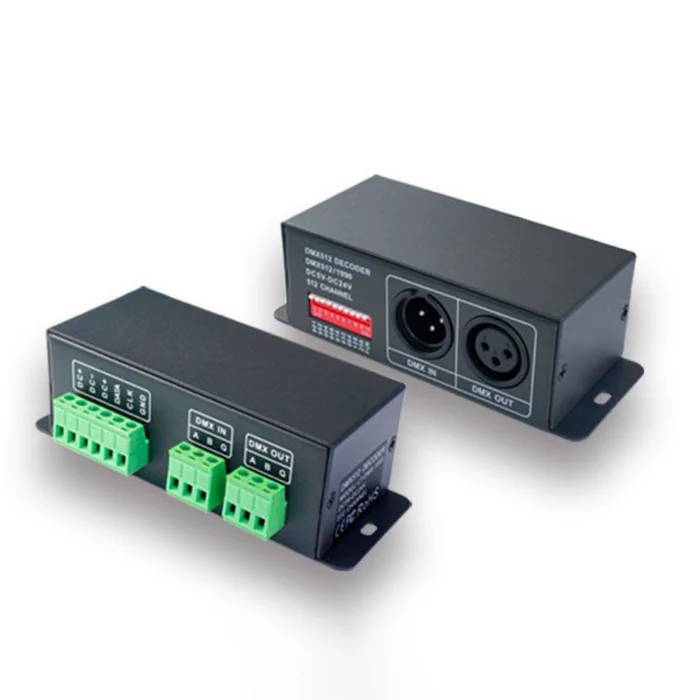
✨ LTech LT-DMX-1809 – DMX to SPI Signal Decoder
Already have a DMX lighting system and want to control pixel LEDs? This decoder converts standard DMX512 signals into SPI data that pixel LEDs understand. Connect it between your DMX desk and your pixel cabochons, strips or modules — and control them just like any other DMX fixture.
Here's how it works: Your DMX controller sends standard DMX512 data via XLR cable. The LT-1809 receives that signal, converts it into SPI protocol, and sends it to your pixel LEDs. Each decoder handles up to 512 channels — that's 170 RGB pixels per unit.
Why it matters: Pixel LEDs speak SPI. DMX desks speak DMX512. Without a decoder, they can't communicate. The LT-1809 bridges that gap, letting you integrate pixel products into professional DMX lighting setups without replacing your existing control equipment.
This decoder works with our RGB DMX-SPI Plug-and-Play Cabochons and other SPI pixel products. For stand-alone pixel control without DMX, see the K8000 Pixel Controller instead.
If you're unsure which type of LED system you need, our simple guide breaks down Static, RGB, RGBW, SPI and DMX in plain English: LED Types Explained – Static, RGB, RGBW, SPI & DMX Guide.
- 🔄 DMX512 to SPI Conversion: Bridges professional DMX systems with pixel LED products.
- 📊 512 Channels: Control up to 170 RGB pixels (512 ÷ 3 channels) per decoder.
- ⚡ Wide Voltage Range: Works with 5V, 12V and 24V LED systems.
- 🔌 Professional Connections: 3-pin XLR input/output plus screw terminal backup.
- 🔢 DIP Switch Addressing: Set DMX start address from 1–512 using binary switches.
- 🔗 Daisy Chain Up to 32 Units: Link multiple decoders for large installations.
- 🛡️ 5-Year Warranty: Professional-grade build with CE/RoHS certification.
For system design help or large installations, contact us at sales@weloveleds.co.uk.
💡 What Is a DMX-SPI Decoder?
DMX512 is the professional lighting control standard used in theatres, concerts and entertainment. SPI (Serial Pixel Interface) is the protocol that addressable pixel LEDs use. They're different languages — a decoder translates between them. Connect your DMX system to the decoder input, connect your pixel LEDs to the output, and your DMX desk can now control pixel products.
In Plain English: It lets your professional DMX lighting desk control pixel LEDs that would otherwise need a separate pixel controller.
📐 Technical Specifications
- Model: LTech LT-DMX-1809
- Input Signal: DMX512 (industry standard)
- Output Signal: SPI (TTL) digital protocol
- Input Voltage: 5–24V DC
- Decoding Channels: 512 channels per unit
- Data Speed: 800K (high) / 400K (low) selectable via DIP switch
- DMX Address Range: 1–512 (DIP switch selectable)
- Dimensions: 125 × 64 × 40mm
- Weight: 300g
- Operating Temperature: -30°C to +65°C
- Certifications: CE, RoHS
- Warranty: 5 years
🔧 Installation & Compatibility
- DMX Input: 3-pin XLR socket (industry standard) plus screw terminals
- DMX Output: 3-pin XLR for daisy-chaining to next decoder
- SPI Output: Screw terminals for connection to pixel LEDs
- Daisy Chaining: Up to 32 decoders without signal amplification
- Self-Test Function: 16 built-in test modes for installation verification
Compatible IC Types: WS2811, WS2812, WS2812B, UCS1903, UCS1909, UCS1912, UCS2903, TM1803, TM1804, TM1809, TM1812, GS8206, SM16703 and more.
⚠️ Quality Notes
- Professional installation: Should be installed by someone familiar with DMX systems and pixel LED wiring
- Address calculation: DIP switches use binary weighting — add switch values together to set start address
- Signal integrity: Maintains data quality over long cable runs and multiple decoder chains
- Commercial grade: Designed for continuous operation in professional lighting installations